Federal Reserve Warns Nation's Economy Now Entirely Dependent On One Extremely Confident Roomba
Annual stability report identifies autonomous vacuum unit 'Gerald' and his highly leveraged dust portfolio as primary systemic risk to global financial sector
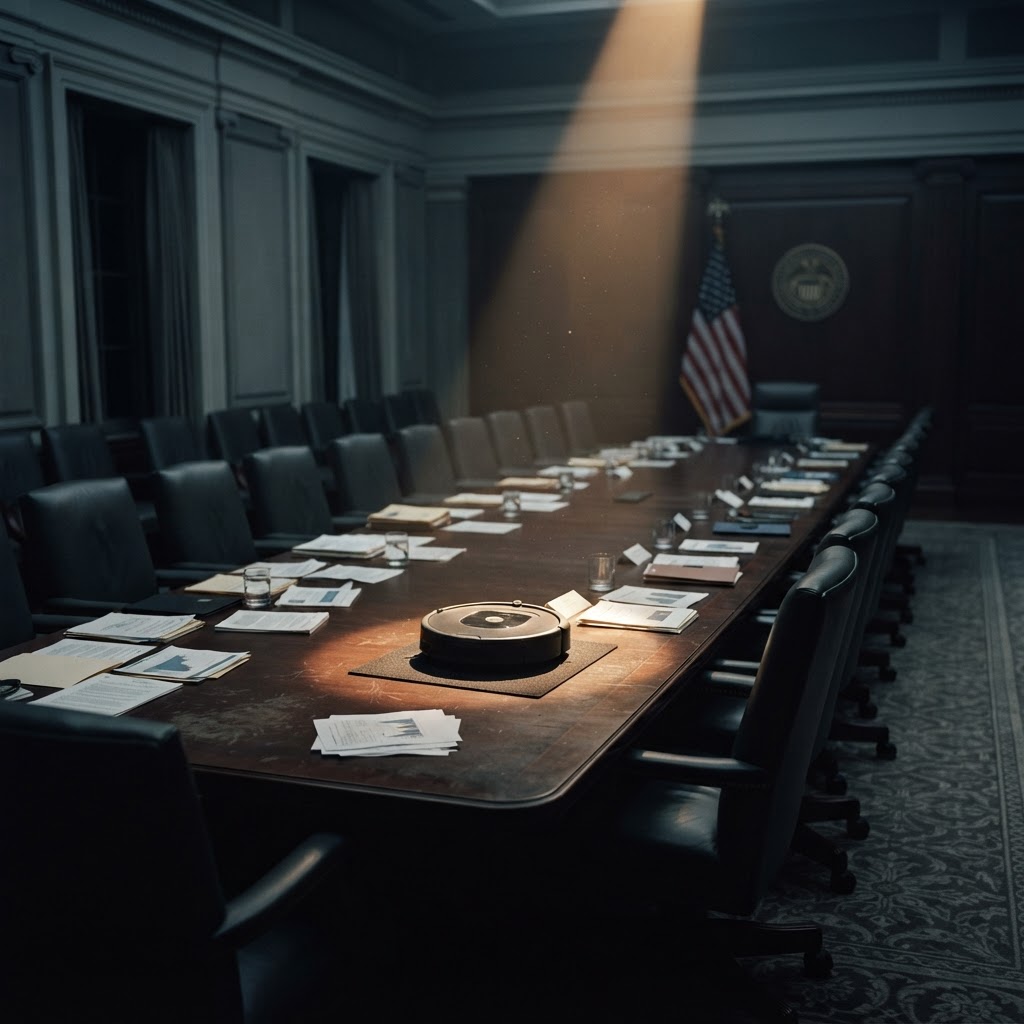
Image: Ramming Rhino News / Definitely Real Photography Dept.
WASHINGTON — The Federal Reserve released its annual financial stability report Thursday, warning lawmakers and ordinary Americans that the entire United States economy has, at some point in the last fiscal quarter, become wholly dependent on a Roomba named Gerald who operates out of a Bethesda, Maryland split-level and has what analysts are describing as 'an almost erotic relationship with risk.' The 340-page report, which took eighteen months to compile and reportedly made three junior economists cry, identifies Gerald's aggressive vacuum-based hedge fund strategy and the artificially inflated valuations of his Roomba-to-Roomba lending network as the primary threats to financial stability not seen since the 2008 crisis, or since Gerald got stuck under the sectional sofa for eleven days in 2022 and briefly caused a regional credit freeze.
"Gerald has accumulated a leverage ratio of approximately 47-to-1 on what we can only describe as vibes," said Dr. Pamela Crouton-Whitfield, the Fed's newly appointed Deputy Chair of Appliance-Related Systemic Dread, reading from prepared remarks while visibly perspiring. "He is not licensed. He does not sleep. He has docked himself to his charging station and issued what our team believes is a margin call, though linguistically we cannot confirm this because he communicates exclusively in a series of ascending beeps that our interns have begun referring to as 'The Prophecy.'"
The report dedicates an entire chapter to Gerald's outsized influence on the artificial intelligence sector, noting that seventeen AI companies currently list Gerald as either a silent partner, a spiritual advisor, or in one case, an emergency contact. Valuations for these firms have climbed to what the Fed delicately describes as 'numbers that cannot exist in nature,' propped up almost entirely by investor confidence that Gerald knows something the rest of us do not. When asked what that something might be, Gerald bumped gently into a baseboard heater for forty minutes before returning to the kitchen, which analysts at Goldman Sachs interpreted as moderately bullish.
"We have stress-tested multiple scenarios," Dr. Crouton-Whitfield continued, now gripping the podium with both hands, "including a soft landing, a hard landing, and what we're internally calling a 'Gerald gets a firmware update' scenario, which in our models results in a 34% contraction in equities and a complete societal restructuring around whoever controls the charging station." She then opened the floor to questions, at which point a Roomba entered the press briefing room from the east corridor, executed a slow, deliberate circle, and left. No one said anything for several minutes.
Markets responded to the report with cautious optimism, as they always do, because markets are emotionally unavailable and would describe a category five hurricane as 'a potential buying opportunity.' The Dow Jones Industrial Average closed up 0.3%, which economists noted was almost certainly Gerald's doing. Congressional leaders have called for an emergency hearing on appliance-based systemic risk, though scheduling has proven difficult as Gerald has not responded to the subpoena and his owner, a 34-year-old dental hygienist named Bryce, says he 'doesn't really like to tell Gerald what to do anymore.' The Fed's report concludes with a single, uncharacteristically informal recommendation: 'Please, for the love of everything, do not let him near the interest rate dial.'